Amino acids come up constantly in fitness and nutrition conversations, but the terminology trips a lot of people up. This guide starts from the beginning: what amino acids actually are, why some are called "essential," and how the eight in Advanced Amino Formula fit into the bigger picture.
What Are Amino Acids?
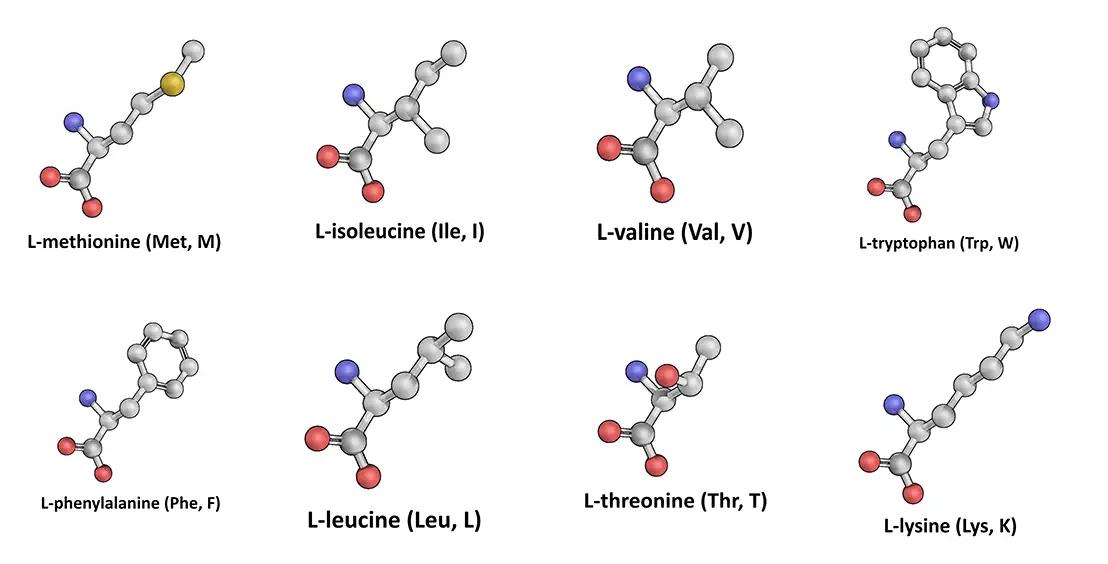
Amino acids are the building blocks of protein. Every protein in the body — muscle tissue, enzymes, hormones, antibodies — is made by linking amino acids together in different sequences and combinations. There are twenty standard amino acids the body uses to build these proteins.
Essential vs. Non-Essential Amino Acids
The twenty amino acids fall into two broad groups. Non-essential amino acids can be synthesized by the body itself from other compounds, so a dietary shortfall isn't automatically a problem. Essential amino acids are different: the body cannot manufacture them at all, or not in meaningful quantities, so they have to come from an outside source — food or supplements.
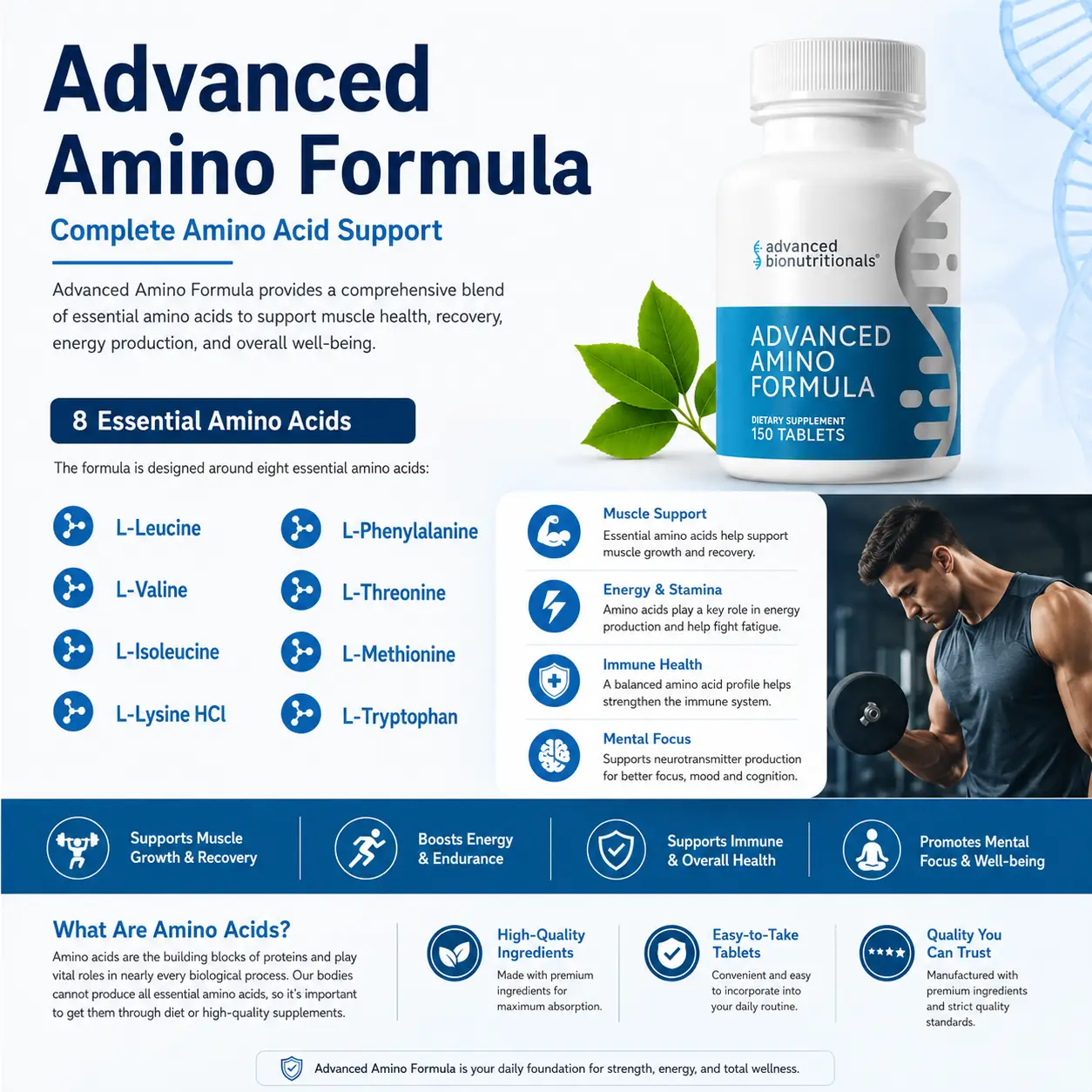
There are nine essential amino acids in total. Advanced Amino Formula provides eight of them in one tablet; the ninth, histidine, is typically obtained through diet.
The Eight Essential Amino Acids in Advanced Amino Formula
| Amino Acid | Category | Commonly Associated With |
|---|---|---|
| L-Leucine | BCAA | Muscle protein synthesis signaling |
| L-Isoleucine | BCAA | Energy metabolism, muscle tissue |
| L-Valine | BCAA | Muscle tissue, nitrogen balance |
| L-Lysine HCl | EAA | Collagen formation, calcium absorption |
| L-Phenylalanine | EAA | Precursor to other compounds in the body |
| L-Threonine | EAA | Connective tissue, gut lining support |
| L-Methionine | EAA | Sulfur-containing metabolic processes |
| L-Tryptophan | EAA | Precursor involved in mood and sleep chemistry |
Notice that the three BCAAs (branched-chain amino acids) are technically a subset of the nine essential amino acids — a distinction we cover in detail in our Advanced Amino Formula vs. BCAA comparison.
See the full eight-amino-acid formula and supplement facts.
View Advanced Amino FormulaWhat Happens Without Enough Essential Amino Acids?
Because the body can't produce essential amino acids on its own, a diet consistently low in them can leave fewer raw materials available for building and repairing protein-based tissue, including muscle. This matters more for certain groups: people eating lower-protein or restrictive diets, older adults (who often need relatively more protein to maintain muscle), and anyone training hard enough that recovery demands increase.
Food Sources of Essential Amino Acids
Complete protein foods — meat, poultry, fish, eggs, dairy, and soy — naturally contain all nine essential amino acids in reasonable proportions. Many plant proteins are lower in one or more essential amino acids individually, which is why combining plant sources (like rice and beans) is a common strategy for plant-based eaters.
- Eggs and dairy — complete protein, widely available
- Poultry and fish — complete protein, lower in saturated fat than some red meats
- Soy, quinoa — rare complete plant proteins
- Legumes, grains, nuts — often need combining for a complete amino acid profile
Where a Supplement Like Advanced Amino Formula Fits In
A supplement isn't a replacement for eating enough protein-rich food. Where it can be useful is convenience: a free-form amino acid tablet delivers the eight essential amino acids without a shaker, a shake, or a full meal, which is one reason people reach for it around workouts or when travel and schedule make consistent meals harder. For a closer look at how this plays out around training specifically, see our muscle recovery guide, and for how it compares with a complete-protein shake, see Advanced Amino Formula vs. whey protein.