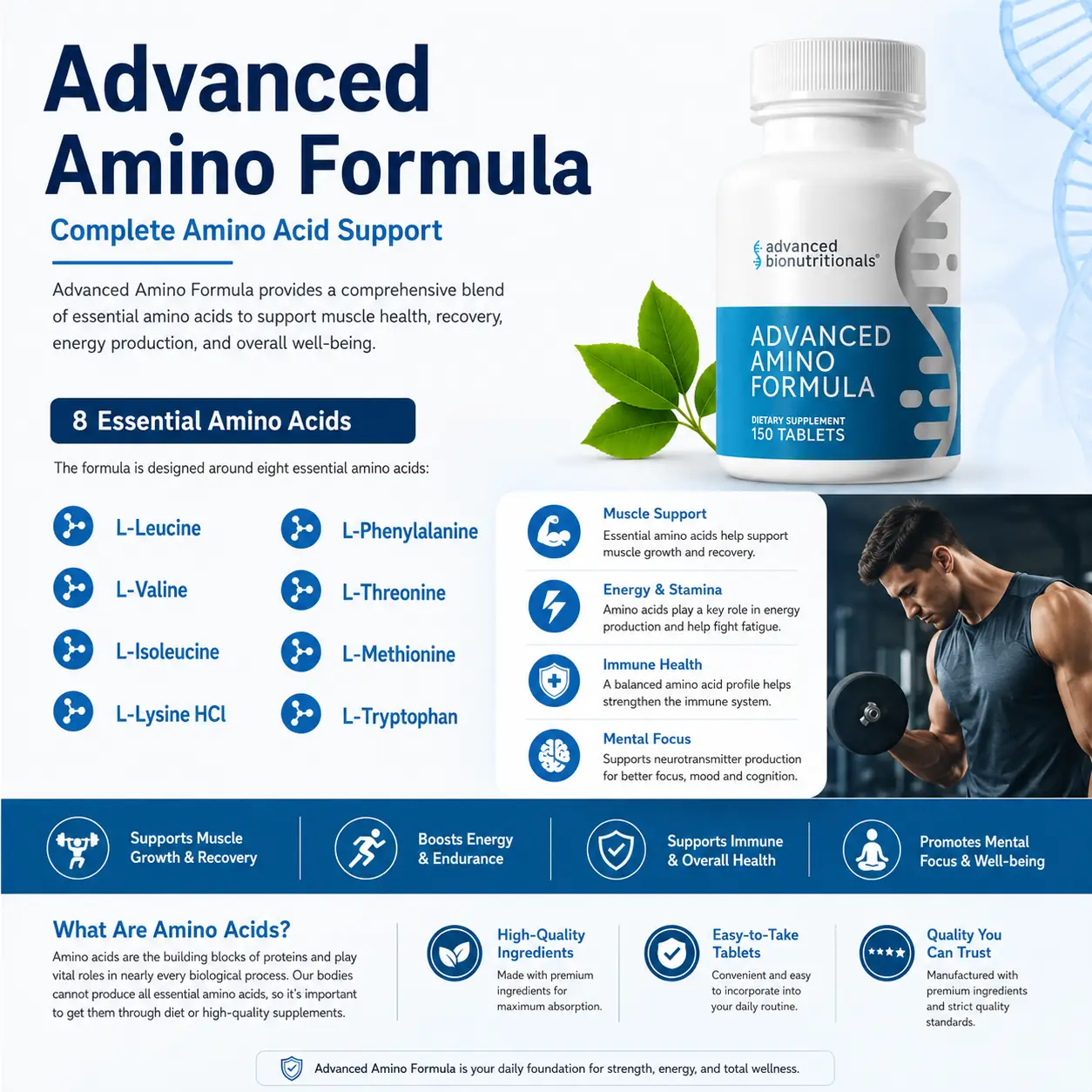
Reading a supplement label full of "L-" names can feel like decoding a chemistry exam. Here's a plain-language walkthrough of what each of the eight essential amino acids in Advanced Amino Formula actually is, and the nutritional role it plays — without exaggerated claims about what any single ingredient can do.
Ingredient Overview
All eight are classified as essential amino acids, meaning the body can't manufacture them in sufficient quantities on its own — they have to come from food or supplementation. Three of the eight (leucine, isoleucine, valine) are also branched-chain amino acids, or BCAAs, a subgroup you may recognize from sports-nutrition products. See our EAA vs. BCAA breakdown for more on that distinction.
L-Leucine
Leucine is probably the most-studied amino acid in this list when it comes to muscle protein synthesis. It participates in cellular signaling pathways connected to how the body builds muscle protein — which is why it's often singled out in EAA marketing. That said, signaling is only one part of a larger process that also depends on having the full range of amino acids available.
L-Valine
Valine is one of the three BCAAs. Its main nutritional role is contributing to normal protein metabolism alongside leucine and isoleucine.
L-Isoleucine
Also a BCAA, isoleucine is involved in amino acid metabolism and general protein nutrition, rounding out the branched-chain trio.
L-Lysine HCl
Lysine is an essential amino acid used by the body in protein formation, alongside other physiological processes. It's one of the amino acids that a BCAA-only product would leave out entirely.
L-Phenylalanine
Phenylalanine is an essential amino acid and a precursor to tyrosine, another amino acid the body uses downstream. Important: people with phenylketonuria (PKU) — a rare genetic condition affecting phenylalanine metabolism — should only use products containing phenylalanine under medical supervision.
L-Threonine
Threonine contributes to normal protein formation. Like lysine, it's a common gap in BCAA-only products since it falls outside the three branched-chain amino acids.
L-Methionine
Methionine is a sulfur-containing essential amino acid involved broadly in protein synthesis and metabolic processes throughout the body.
L-Tryptophan
Tryptophan is an essential amino acid and a known precursor to serotonin and melatonin. Because of that, it can interact with serotonergic medications, including certain antidepressants — another reason to check with a healthcare professional before combining it with prescription medication.
See how these eight amino acids come together in one daily formula.
View Advanced Amino FormulaThe Eight Amino Acids at a Glance
| Amino Acid | Type | Primary Nutritional Role |
|---|---|---|
| L-Leucine | BCAA | Muscle protein synthesis signaling |
| L-Valine | BCAA | Normal protein metabolism |
| L-Isoleucine | BCAA | Amino acid & protein metabolism |
| L-Lysine HCl | EAA | Protein formation |
| L-Phenylalanine | EAA | Tyrosine precursor |
| L-Threonine | EAA | Protein formation |
| L-Methionine | EAA | Sulfur-containing protein metabolism |
| L-Tryptophan | EAA | Serotonin & melatonin precursor |
No dosage figures are listed here because exact per-tablet amounts should always be confirmed on the current product label rather than assumed from a third-party article.